
Building the Evidence Base for Sustainable Repatriation (SCORE)
Understanding what makes voluntary repatriation genuinely sustainable for returnees, governments, and communities
For many people living far from home, the decision to return is rarely simple, but it should always be an informed one. Voluntary repatriation, the process by which individuals with legal residence abroad choose to return to their country of origin, can mean reuniting with family, rebuilding a life in familiar surroundings, or seizing new opportunities created by a changing situation at home. Yet the moment of return is also, too often, the moment support runs out. SCORE (Strengthening Conditions for Repatriation) is Seefar's response to that gap: a research project designed to understand what makes reintegration, rebuilding a life back home after returning from abroad, genuinely sustainable.
Note: This project is still ongoing. The results presented here are from preliminary reports.
The Challenge
Across Europe, governments fund voluntary return through financial packages and reintegration grants, yet far less attention has historically been paid to what happens after arrival, whether people genuinely reintegrate, what supports them, and what causes even well-resourced returns to unravel.
Our Approach
SCORE delivers a phased research programme combining structured landscape analysis across 13 countries, in-depth qualitative fieldwork with returnees and stakeholders, multi-country policy dialogue, and the design of practical pilots, including a referral mechanism and capacity-building programme.
Project Details
| Timeline | 6 December 2024 – 31 December 2026 |
| Locations | Somalia, Syria, Iraq, Ethiopia, Bosnia and Herzegovina, Serbia |
| Target Audiences | Repatriates who have left Sweden or intend to return to their countries of origin; governments of those countries. Secondary audiences are CSOs and NGOs in Sweden. |
| Overall Aim | To improve the sustainability and development alignment of voluntary repatriation support |
Why Voluntary Repatriation Needs a Better Evidence Base
Across Europe, governments fund voluntary return through financial packages, travel assistance, and reintegration grants. This support is offered both to manage migration pressures and because facilitating a dignified return for those who hold legal residence is widely seen as a practical and ethical obligation. Sweden has gone further than most: under its new global strategy on migration and development, the Swedish Migration Agency is substantially increasing per-person repatriation support, with the aim of making returns not just financially supported, but sustainable.
That shift in ambition raises a harder question: sustainable for whom, and how? Far less attention has historically been paid to what happens after arrival. This includes understanding whether people reintegrate, what supports them to do so, and what causes even well-resourced returns to unravel. To respond to these challenges, the Swedish Migration Agency commissioned Seefar to design and deliver SCORE.
Research, Engagement, and Piloting: SCORE's Phased Approach
Landscape Mapping
Mapped the voluntary repatriation landscape across 13 countries, including Somalia, Ethiopia, Iraq, Syria, Bosnia and Herzegovina, Serbia, Nigeria, Türkiye, and Pakistan. Through structured analysis of governance conditions, economic stability, diaspora dynamics, and partnership potential, narrowed the field to six focus countries for deeper engagement.
Qualitative Ecosystem Research
Documenting the lived experiences of repatriates through in-depth interviews, focus groups, and key informant consultations across all six focus countries. Convening multi-stakeholder workshops that bring together governments, civil society, international organisations, and diaspora networks to co-develop strategies for improving reintegration support.
Pilot Design and Testing
Designing and testing practical pilot interventions based on the research findings: a referral mechanism connecting repatriates with in-country support, a digital outreach and capacity-building programme for the Swedish Migration Agency, and an evaluation framework to assess long-term impact.
Understanding Repatriation: What the Research Reveals on Drivers, Decisions, and Reintegration
The centrepiece of Phase 2 is The Repatriation Journey, a landmark qualitative study engaging 329 participants, including 66 repatriates who returned from Europe to their countries of origin between 2018 and 2024, across five countries (Somalia, Iraq, Ethiopia, Bosnia and Herzegovina, and Serbia) and six contexts, Iraq being counted twice to reflect the distinct conditions in the Kurdistan Region and federal Iraq. It is the most comprehensive study of its kind commissioned by the Swedish Migration Agency to date.
The study's findings challenge some common assumptions. Repatriation decisions are rarely driven by a single factor. Economic hardship, insecure residency status, and social exclusion in Europe often act as push factors, while caregiving responsibilities and concerns over children's cultural identity serve as equally powerful pulls. Gender, education level, and household power dynamics all significantly shape who decides to return, and when. Women more frequently cite caregiving responsibilities, while men more often report hardship or disappointment abroad; higher education is associated with more planned, forward-looking returns, whereas limited formal schooling correlates with reactive returns driven by economic or legal pressure. In some cases, patriarchal norms or elder authority determine outcomes entirely.
A smaller but important group returns due to positive developments in their home country such as improved security, new economic opportunities, or political reform. This points to the potential for programmes to leverage moments of stability rather than simply managing distress.
The research also maps what happens after arrival. The majority of repatriates receive no pre-departure assistance, most commonly because they are unaware that support is available; others decline due to distrust of institutional processes or a preference for self-reliance. Effective reintegration, the study finds, requires individual assessment, tailored planning, and phased support that accompanies the returnee well beyond the initial financial package. One-size-fits-all approaches consistently underperform. Social stigma toward returnees remains a persistent barrier in several contexts, and community-level reconciliation work is identified as a precondition for durable outcomes.
Taking Findings to Decision Makers: Workshops, Webinars, and Policy Dialogue
Research findings are only valuable if they reach the people who can act on them. SCORE builds dissemination into its core design.
In January 2026, Seefar and the Swedish Migration Agency hosted a webinar in Stockholm presenting The Repatriation Journey findings to government immigration officials from six European countries: Austria, Belgium, Germany, Finland, Norway and Sweden. The session drew 38 registered attendees, positioning SCORE as a reference point for the broader European debate on voluntary repatriation policy.
In March 2026, the team delivered a two-day national workshop in Nairobi, convening key actors in Somalia's voluntary repatriation and reintegration landscape. Day one brought together representatives of the Somali federal government, including the Ministry of Interior, the Office of the Prime Minister, and the National Commission for Refugees and IDPs, alongside the Swedish Embassy. Day two engaged civil society organisations, reintegration practitioners, and international actors including IOM, UNHCR, and DRC. Across both days, 58 participants contributed to concrete recommendations on how Swedish repatriation support can be better designed and coordinated.
"If we are still measuring reintegration by the assistance we deliver rather than the stability we produce a year later, we have not yet built the architecture sustainable reintegration requires. If we are not simultaneously addressing the conditions and pressures that drive irregular migration, we will remain better at responding to it than reducing the factors that sustain it."
– IOM Representative, Somalia workshop in Nairobi"Sustainable economic reintegration requires long-term, market-driven, and individualised support that aligns returnees' capacities with real economic opportunities while managing expectations and strengthening local systems."
– KAALO Aid and Development Representative, Local NGO, Somalia workshop in Nairobi"We need counsellors based in-country as an integral part of the repatriation process, to give potential returnees a realistic picture of what to expect before departure, not after arrival."
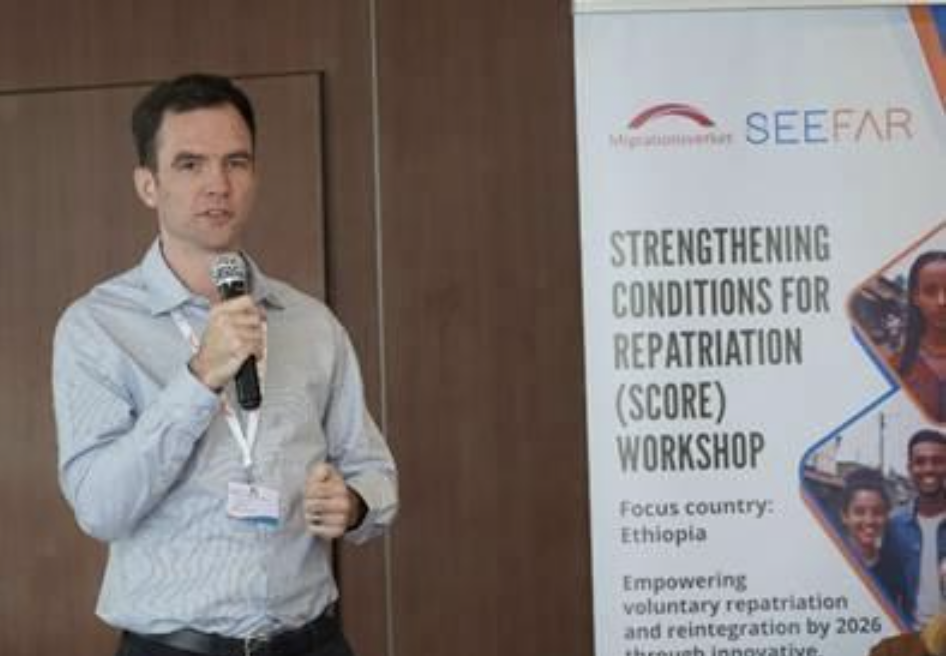
– Somali NGO Consortium Representative, Somalia workshop in NairobiIn May 2025, Seefar also convened a stakeholder workshop in Addis Ababa, Ethiopia, bringing together key actors in the voluntary repatriation and reintegration landscape as part of Phase 2's in-country engagement programme.
"Sustainable economic reintegration of returnees requires an integrated support package: economic, social, and psychosocial, delivered through continuous programming with strong local ownership, community participation, and private sector engagement."
– Member of Caritas Ethiopia (ECC-SDCO), Panel Discussion, Addis Ababa"Repatriates bring skills that can transfer and improve efficiencies across different industries. That potential needs to be recognised and channelled deliberately."
– Workshop Participant, Addis AbabaInnovation Highlight: From Arrival to Reintegration
The SCORE project is designed not to leave repatriates alone to navigate in-country support systems after arrival. There are mechanisms in place to connect individuals with vetted local services such as vocational training, psychosocial support, economic inclusion programmes, or other economic activities matched to their individual profile. In practice, this means that a repatriate arriving in Mogadishu or Addis Ababa would be matched, based on their skills, household situation, and economic needs, to a pre-mapped network of local service providers, rather than left to navigate an unfamiliar landscape alone. This infrastructure does not exist yet in voluntary repatriation programming at scale. The Phase 3 pilot, which will test a practical referral system connecting returnees to in-country support, has significant potential for adoption by the Swedish Migration Agency and other European migration agencies if results are positive.
The Syria research strand is also generating insights with relevance well beyond this project. Multiple European governments are seeking to understand the repatriation landscape in post-conflict Syria, and SCORE's field-based findings are filling a gap that desk-based analysis cannot. Syria research is currently under way, with field researchers hired, and a final report expected by June 2026.
Key Achievements
13 countries screened in Phase 1 to identify optimal focus countries for sustainable repatriation support
329 participants engaged in The Repatriation Journey qualitative study, including 66 repatriates who returned from Europe between 2018 and 2024
6 European governments reached through the January 2026 policy webinar in Stockholm (Austria, Belgium, Finland, Germany, Norway, Sweden)
58 stakeholders convened at the Somalia workshop in Nairobi, including Somali federal government ministries, the Swedish Embassy, IOM, UNHCR, and local civil society
6 focus countries now in active Phase 2 research: Somalia, Iraq, Ethiopia, Bosnia and Herzegovina, Serbia, and Syria
Phase 3 pilot in development — referral mechanism and Swedish Migration Agency capacity-building programme
Looking Ahead
By the end of 2026, SCORE aims to have delivered: a complete evidence base across six countries; a tested referral and support mechanism for voluntary repatriates; and a set of actionable recommendations that the Swedish Migration Agency and partner governments can carry forward into the next phase of Europe's repatriation policy landscape.