
From Classrooms to Smartphones: How SAFE-MIT is Changing Migration Narratives Among African Youth
Equipping teachers, driving evidence-based campaigns, and helping young people across four countries make genuinely informed migration decisions
For many young people across Africa, the decision to migrate is one of the most difficult choices they will ever face, and it is rarely made with an accurate picture of the risks. The journey to Europe often feels like the only path to a better future, but the realities on the ground are frequently at odds with expectations. In Senegal alone, only 40% of young people aged 17–30 are fully aware of the risks of irregular migration. In Nigeria, 72% of young respondents expect European countries to help them find work on arrival, and 68% believe they will secure employment within two months. Social media amplifies these myths: most migration-related content seen by Nigerian teenagers portrays irregular migration positively.
SAFE-MIT, "A Shared Foundation to Protect Against Risks of Irregular Migration and Trafficking", is Seefar's response. A 17-month programme that operates across Kenya, Morocco, Nigeria and Senegal, with capacity-building on social media extending to Ethiopia, Uganda, Tunisia and The Gambia. The project equips teachers to conduct immersive awareness sessions with students in the classrooms, and drives evidence-based, influencer-endorsed content across social media to help young people develop their critical thinking skills and make genuinely informed choices about their futures.
Note: This project is still ongoing. The results presented here are from preliminary reports.
The Challenge
Across Africa, young people make migration decisions under heavy social media influence and with limited accurate information. In Nigeria, 72% expect European countries to help them find work on arrival; in Senegal, only 40% are fully aware of the risks of irregular migration.
Our Approach
SAFE-MIT equips secondary school teachers to deliver migration education using the Escape Game methodology, runs evidence-based social media campaigns amplified by trusted influencers, and builds a multilingual digital platform serving all four countries plus neighbouring partners.
Project Details
| Timeline | 1 March 2025 – 31 October 2026 (17 months) |
| Locations | Kenya, Morocco, Nigeria, Senegal. Neighbouring partners: The Gambia, Ethiopia, Uganda, and Tunisia |
| Target Audiences | Teachers; students; potential migrants reached via social media |
| Beneficiaries Reached | 1,107 teachers trained across 34 sessions; 42M+ individuals reached via Meta and TikTok; 14M+ engagements; 108 content pieces on informedmigration.org |
"The project moved my students from awareness to conscience."
– Mustapha Hammed, secondary school teacher, St John's Junior Secondary School, Kwara State, NigeriaHow the Project Worked
The Escape Game: Experiential Learning That Resonates With Youth and Educators
At the heart of SAFE-MIT's classroom methodology is Seefar's Escape Game, an interactive learning experience proven effective in driving behaviour change around irregular migration across multiple countries and contexts. Rather than sitting through a lecture on migration risks, participants work in small teams to navigate real-world migration dilemmas together. They make decisions, weigh consequences, and build empathy through the process. This immersive, highly interactive approach has consistently generated high engagement and significant knowledge change among youth and educators.
SAFE-MIT trained secondary school teachers to deliver migration education within existing curricula, delivered through four trusted local partners: The Youth Café (Kenya), YES – Youth Empowerment Society (Morocco), MeCAHT (Nigeria) and AJDL (Senegal).
As of May 2026, 1,255 teachers have been trained across 40 sessions in the four countries, against a target of 1,200. Pre- and post-training assessments confirm strong impact: 77% of trained teachers demonstrate increased knowledge of irregular migration risks, the realities of life in Europe and available alternatives. Overall satisfaction is high at 99%, with those participants recommending the training to a colleague.
For SAFE-MIT, the Escape Game initially developed for Moroccan students in the NLM project has significantly expanded across three additional countries (Kenya, Nigeria, and Senegal); each version contextualised to local migration realities, languages and classroom settings. Partners conducted participatory reviews of Seefar's existing materials, adapting them for national education standards, cultural contexts and classroom realities. All materials were approved by local educational authorities before project implementation.
In school support sessions delivered by trained Educational Outreach Officers (EOOs), staff who guide students through the game, found that 96% of students grasped key concepts, with engagement reaching 85% during game play and 81% in follow-on discussions.
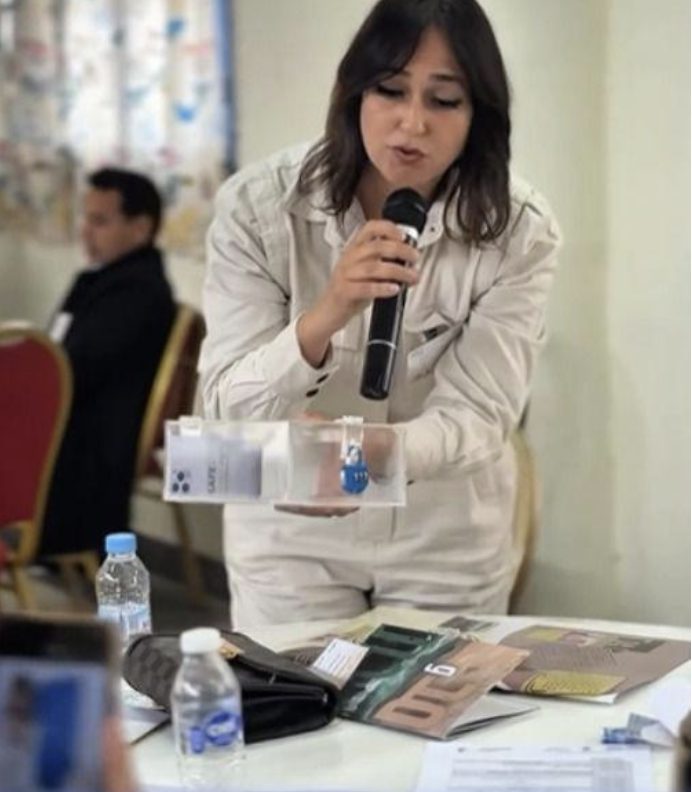
SAFE-MIT Escape Game sessions in secondary school classrooms
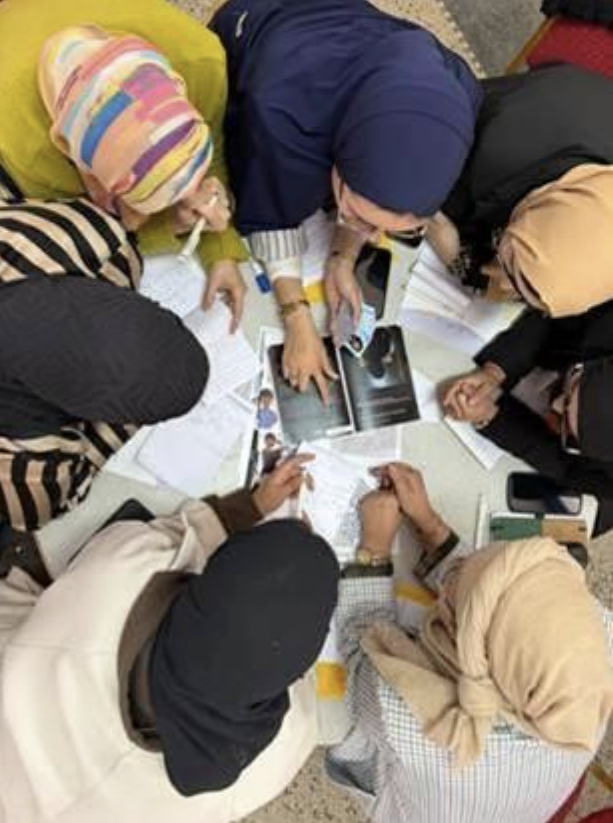
From Morocco to Kenya, Senegal, and Nigeria, the Escape Game allows students to live, rather than only hear, information about irregular migration
Voices from the Classroom: Teachers on Why the Method Works
The testimonials from teachers capture why the method works. In Senegal, Tidiane Diop, a Spanish teacher at CEM Tatène in the Thiès region, describes an experience that transformed his understanding:
"Before this session, my knowledge of migration was limited. The Escape Game is interesting, engaging, and highly informative. It helps participants better grasp the realities faced by migrants in transit and destination countries, the dangers they encounter, as well as local alternatives and the misinformation circulating on the subject. We plan to use this valuable tool to raise awareness in both schools and communities."
– Tidiane Diop, Spanish teacher, CEM Tatène, Thiès region, SenegalIn Morocco, Sara Grounjar, a French teacher at Imam Ali Middle School in Salé, says the session:
"will undoubtedly help guide our students in their thinking and encourage them to make safe and responsible choices, rather than exposing themselves to risks that could endanger their lives."
– Sara Grounjar, Teacher and Escape Game Facilitator, MoroccoIn Nigeria, Mustapha Hammed describes a moment that captures what the Escape Game uniquely achieves. After a session in Kwara State, one of his students asked:
"Sir, what happened to the people in the game? She wasn't asking about fictional characters; she was asking about people. My students weren't just listening, they were living the experience, facing impossible choices."
– Mustapha Hammed, Teacher and Escape Game Facilitator, NigeriaThat moment, he says, "moved his class from awareness to conscience".
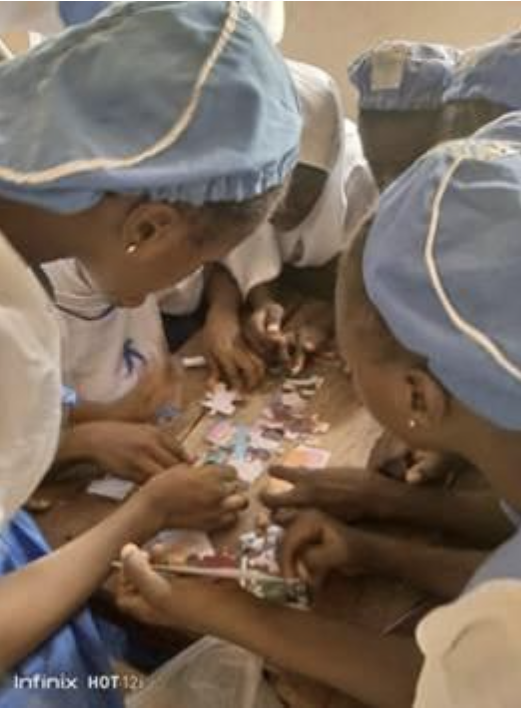
Teachers across four countries adapt the Escape Game to local migration realities, languages, and classroom settings
Before They Leave: A Kenyan Teacher on the Front Line of Safe Migration
Wanjiru, a Competency Based Education (CBE) teacher at Maina Wanjigi Secondary School in Nairobi, was already acutely aware of the risks of irregular migration before she joined SAFE-MIT. She had witnessed students abruptly leaving Kenya mid-education for countries like Canada and the United States, and had handled the difficult cases that followed. One male student was deported from Canada and returned in severe distress, requiring extensive psychosocial support to reintegrate. A female student was taken to Somalia under false pretences, narrowly escaping forced marriage before finding her way back through unsafe routes.
SAFE-MIT gave Wanjiru the tools to respond more effectively: strengthened guidance and counselling skills, and the ability to connect students with accurate, reliable migration information. Since completing the training, she has actively promoted safe and regular migration pathways, helping students make informed, empowered decisions about their futures. Both students she supported are now moving forward: the young man has found alternatives to migration within Kenya, while the young woman is exploring legal routes to the United States.
Name has been changed to preserve teachers' and students' privacy.
Informedmigration.org: A Multilingual Digital Platform Built to Last
SAFE-MIT's technology highlight is www.informedmigration.org, a multilingual digital platform designed to support the programme and remain a living resource long after it ends. Available in English, French and Arabic, the platform hosts country-specific sub-platforms for all four countries, each populated with locally relevant campaign content, teacher resources, interactive learning tools and information on alternatives to irregular migration.
The platform currently hosts 108 curated content pieces, including five interactive games (The Journey, Real or Rumour, Build Your Future, Cost of the Journey and Future Builder Quiz), a 10-question myth-busting quiz, and country-specific video galleries from the project's Facebook and TikTok campaigns. All tools are designed for use in classrooms and by young people independently.
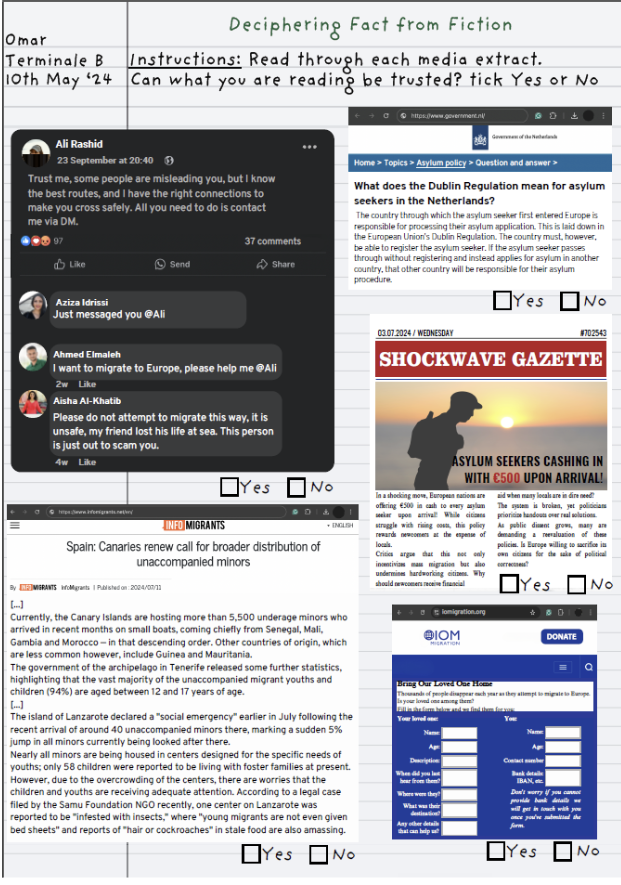
informedmigration.org, in English, French and Arabic, with country-specific sub-platforms
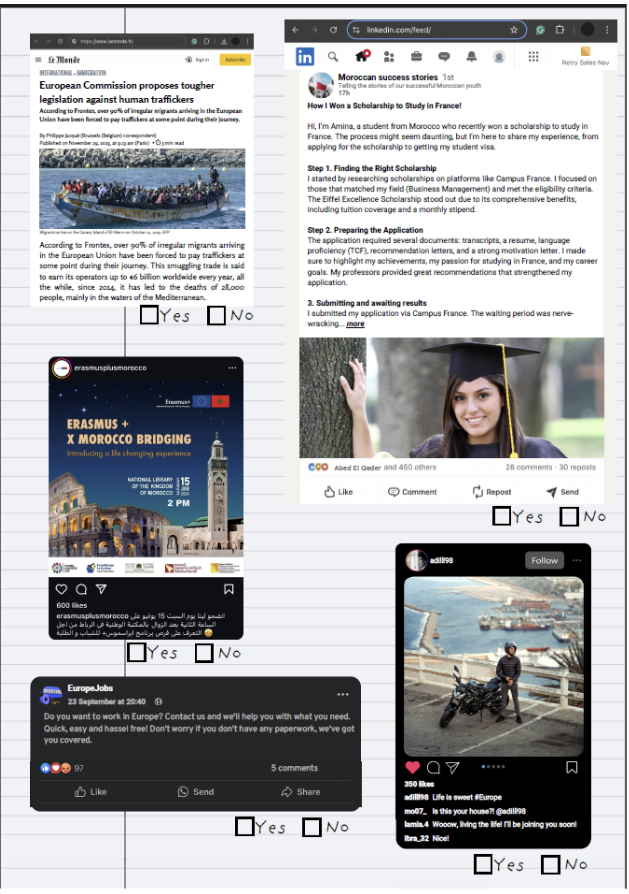
Interactive games and teacher resources designed for classroom use and independent learning
Social Media Campaigns Built on Evidence, Amplified by Influence
Across 16 campaigns launched on Meta and TikTok under The Migrant Project (TMP) brand, which runs through dedicated local TMP social media pages in each country, SAFE-MIT has reached over 42 million individuals and generated more than 14 million engagements. In Morocco alone, four campaigns reached over 12 million people. The campaigns are rigorously data-driven: 20 rounds of A/B testing were completed across the four countries, exceeding the target of 16, to determine the most effective content and messaging. Hope-based messaging led in Kenya and Morocco, while risk-based messaging resonated most strongly in Senegal, reflecting different migration cultures and media habits in each country. A/B testing found that short-form video (15–30 seconds) consistently outperforms static image formats.
Optimising the message is one lever; the other is ensuring it is delivered by voices young people already trust. Eleven social media influencers, carefully selected, vetted and contracted across the four countries, are publishing posts, stories, and reels designed to debunk myths and inform young people about the realities of irregular migration and the alternatives available locally. Their content spans fictional series, selfie-style videos, polls, and interactive Q&As, a deliberate variety of formats set to total 100 posts across all influencers and countries by the campaign's close. Having these messages endorsed by voices young people already follow and trust is a proven way to spark community conversations, cut through misinformation, and deliver critical content through the channels where youth are most present and most receptive.
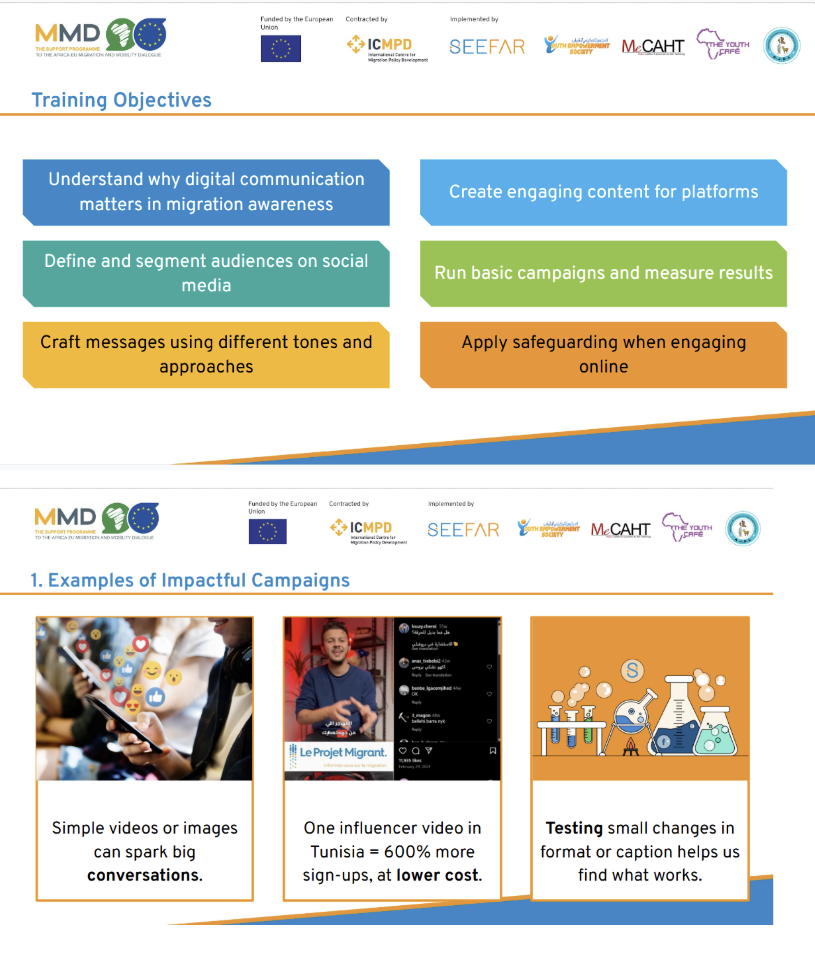
SAFE-MIT social media campaigns under The Migrant Project (TMP) brand, reaching 42 million+ individuals across four countries
Building Local Capacity for the Long Term
A defining feature of SAFE-MIT is its commitment to local ownership. The project builds the technical, operational and communications capacity of partner organisations so they can continue this work independently. This extends to "neighbouring partners" in Ethiopia, Uganda, Tunisia and The Gambia: four NGOs trained by Seefar to run their own social media campaigns on irregular migration. All 16 staff from partner organisations in neighbouring countries demonstrated improved knowledge following training, with a 100% success rate against a 60% target, and are successfully running their own localised social media campaigns.
"Before SAFE-MIT social media training, we were limited to simply boosting posts. The training transformed how we work, giving us a far more strategic and data-driven approach to campaign management. We now build every post around a hook that stops the scroll, a caption that tells a story, and a call to action that prompts reflection. We are now on track to reach 1.25 million people, ahead of schedule. The results speak for themselves."
– Aymen Zawali, Ichrak Belhoula and Houda Jouini, Association Capsa Horizons / Radio Capsa FM, Tunisia"The training helped us move from ad hoc posting to professional, evidence-based campaigns. Using audience targeting, A/B testing, and empowering messaging such as 'safe migration is the only real freedom'. We can now identify who is most vulnerable to irregular migration and reach them with content that inspires safer choices."
– Ahmed A. Salami, Director, Worldview The GambiaKey Achievements
1,107 teachers trained across 34 sessions in four countries, with 77% demonstrating increased knowledge of irregular migration risks, exceeding the 60% target
95.9% of students in Escape Game sessions grasped key migration concepts, with 84.7% engagement during game play
42 million+ individuals reached via 16 social media campaigns on Meta and TikTok, generating over 14 million engagements across four countries
108 content pieces live on informedmigration.org, a multilingual platform in English, French and Arabic (target: 100)
100% of neighbour partner staff in Ethiopia, Uganda, Tunisia and The Gambia demonstrated improved communications skills post-training (target: 60%)
20 rounds of A/B testing completed across four countries, exceeding the target of 16, to optimise content and messaging
Looking Ahead
In September 2026, the project will hold four country-level closing events and a dedicated learning event in Kenya, bringing together implementers and stakeholders to share lessons. A short documentary and testimonial video series, filmed across all four countries, will capture the human stories that define this project. By close, SAFE-MIT aims to have equipped over 1,200 teachers, reached 65,000 students in classrooms, built social media campaigning capacities of multiple CSOs, and established a multilingual digital platform and a tested, replicable model that any organisation working on migration awareness can adopt.